


At the National Governors Association Winter Meeting in February, Oklahoma Governor Kevin Stitt invited his fellow governors to sign a Compact on Entrepreneurship. The signatories will be announced at the NGA Summer Meeting in Oklahoma City this July. Between now and then, every governor’s office in the country is making a quiet decision about whether to put their name on it.
The Compact itself is worth reading. It asks governors to name senior officials dedicated to entrepreneurship, establish resource hubs for founders, set goals for reducing the time and cost of starting a business, and, critically, measure and publicly report on startup activity and its downstream impact. It is framed as bipartisan infrastructure, with Stitt (R-OK) as NGA Chair and Maryland Governor Wes Moore (D-MD) as Vice Chair closing the Winter Meeting together.
The Compact itself is less interesting than the fact that governors are discussing it at all.
To understand why they are paying attention, you have to look at two forces converging underneath the Compact.
The fragility the national numbers are hiding
The headline story about the American economy in 2026 is that it is growing. AI investment is surging, the stock market is up, and productivity gains in some industries are real and measurable. AI optimists have built a large part of their pitch on the idea that the technology will expand demand rather than destroy it.
All of that is true.
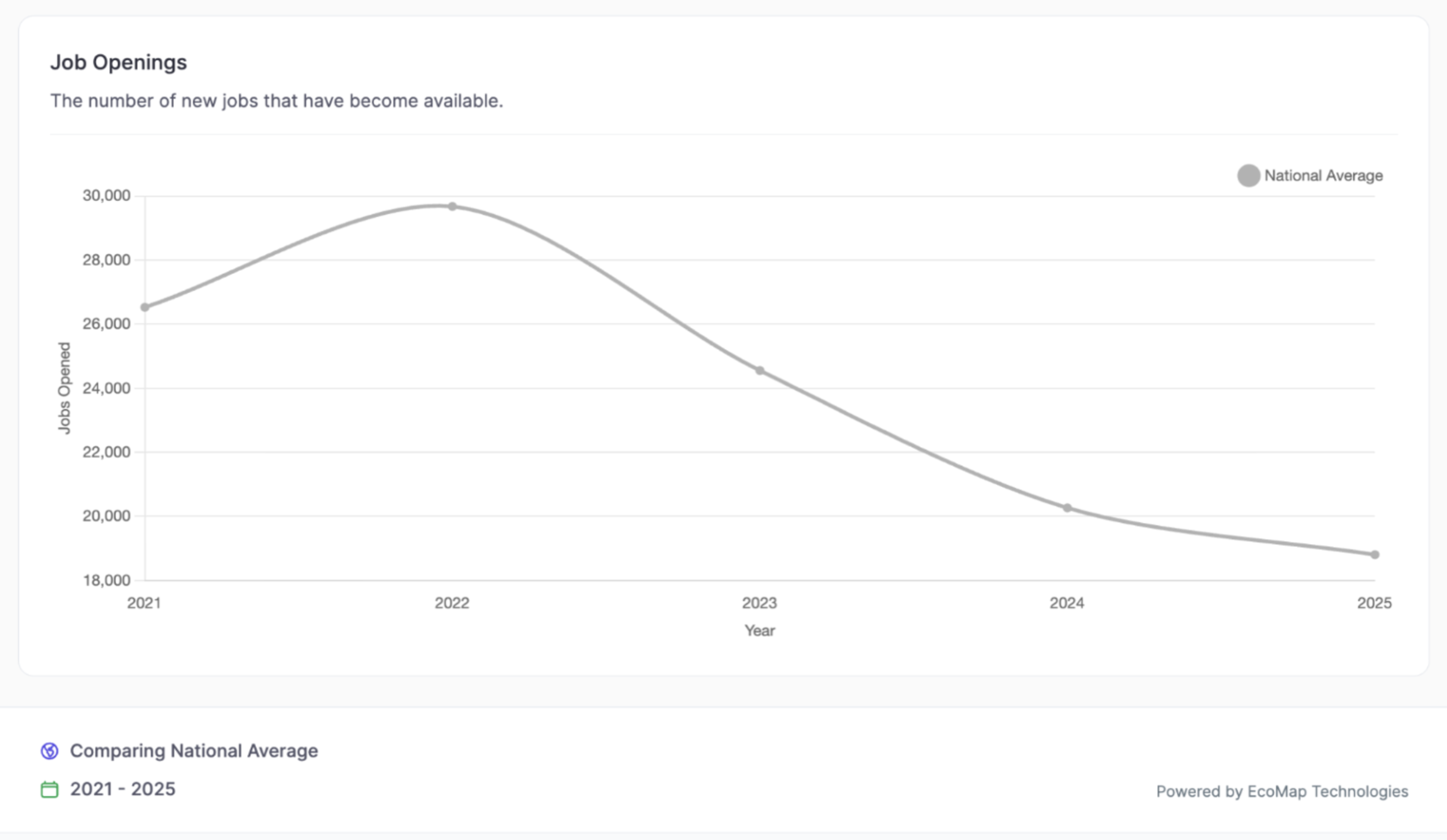
But the underlying picture tells a different story. According to Moody’s Analytics chief economist Mark Zandi, 22 states plus the District of Columbia are currently either in a recession or at high risk of entering one. Together, they represent roughly a third of U.S. GDP. Zandi's list describes current conditions, based on payroll employment, unemployment insurance claims, industrial production, retail sales, building permits, and state tax revenues. It is a map of economic strain that runs from the Northeast through the Midwest to the Pacific Northwest.
Zandi has been explicit about what is holding the national number up. AI-driven investment, the stock market, and the wealth effect on high-income household spending are, in his words, a tailwind to growth. The rest of the country is contracting underneath that tailwind. He told Fortune that lower- and middle-income households are “hanging on by their fingertips.” He warned that if the softness spreads from smaller manufacturing states to California or New York, the national story reverses overnight.
This is the Gross Domestic Prosperity argument made by a mainstream economist. Output is not prosperity. Growth is not resilience. A number that averages across 50 states can be rising while most of those states are sliding. Governors in the 22 states on Zandi’s list do not need to read a white paper to know this. They are reading it in their unemployment claims and their sales tax receipts every week.
The cliff nobody is routing around
The second force is quieter, but it is the one that will matter most over the next decade.
By 2035, roughly 2.3 million small and medium-sized businesses in the United States will face ownership transitions as the baby boomer generation retires. More than one million of those are viable candidates for sale, meaning they have profitable operations, established customer bases, and the kind of embedded local knowledge that takes a generation to build. The question is whether the businesses find successors or close.
Small businesses are not a sentimental category. They are 99 percent of U.S. firms, employ more than 60 million workers, and generate about 35 percent of business revenue. They are also, structurally, how economic resilience works.
Resilience is the word every governor, mayor, and economic developer reaches for when a shock hits, and it is almost always used without a mechanism attached to it.
The mechanism is risk distribution. When economic control is concentrated in a handful of large employers, a regional shock wipes out a community.
When it is distributed across thousands of small owners, the community absorbs the shock and adapts. Resilience is the outcome. Risk distribution is how you get there. That absorption capacity is not accidental. It is the compounding result of decades of people choosing to start and run things.
Now consider what happens if those one million transitions fail. Not all at once, not dramatically, but at the ordinary rate of a retiring owner who cannot find a buyer and closes the doors. Each closure is a handful of jobs lost, a commercial corridor that loses a tenant, a supplier relationship that evaporates, a pool of local expertise that disappears. Multiply that across a decade, and the result is the slow erosion of the thing that made communities economically resilient in the first place. That is more corrosive than any single recession.
There is no coordinated pipeline between workforce development programs, small business lenders, entrepreneur support organizations, and the businesses that need to be acquired. There is a national conversation about upskilling workers for the AI economy, and a separate conversation about small business succession, and almost no conversation about the fact that these are the same conversation. More on that thread can be found in this Inc. Article.
The equilibrium question
To me, it’s clear that AI will displace some share of the American workforce over the next decade. The actual number is contested. What is not contested is that the displacement will not be evenly distributed. It will concentrate in specific occupations, industries, and places, many of which are likely to overlap with the 22 states already on Zandi’s recession list.
At the same time, the ownership transition cliff will push more than a million viable businesses into the market looking for successors.
Is that equilibrium?
Nobody knows, because nobody is measuring the supply side of ownership the way we measure the supply side of labor. We count jobs, wages, and unemployment.
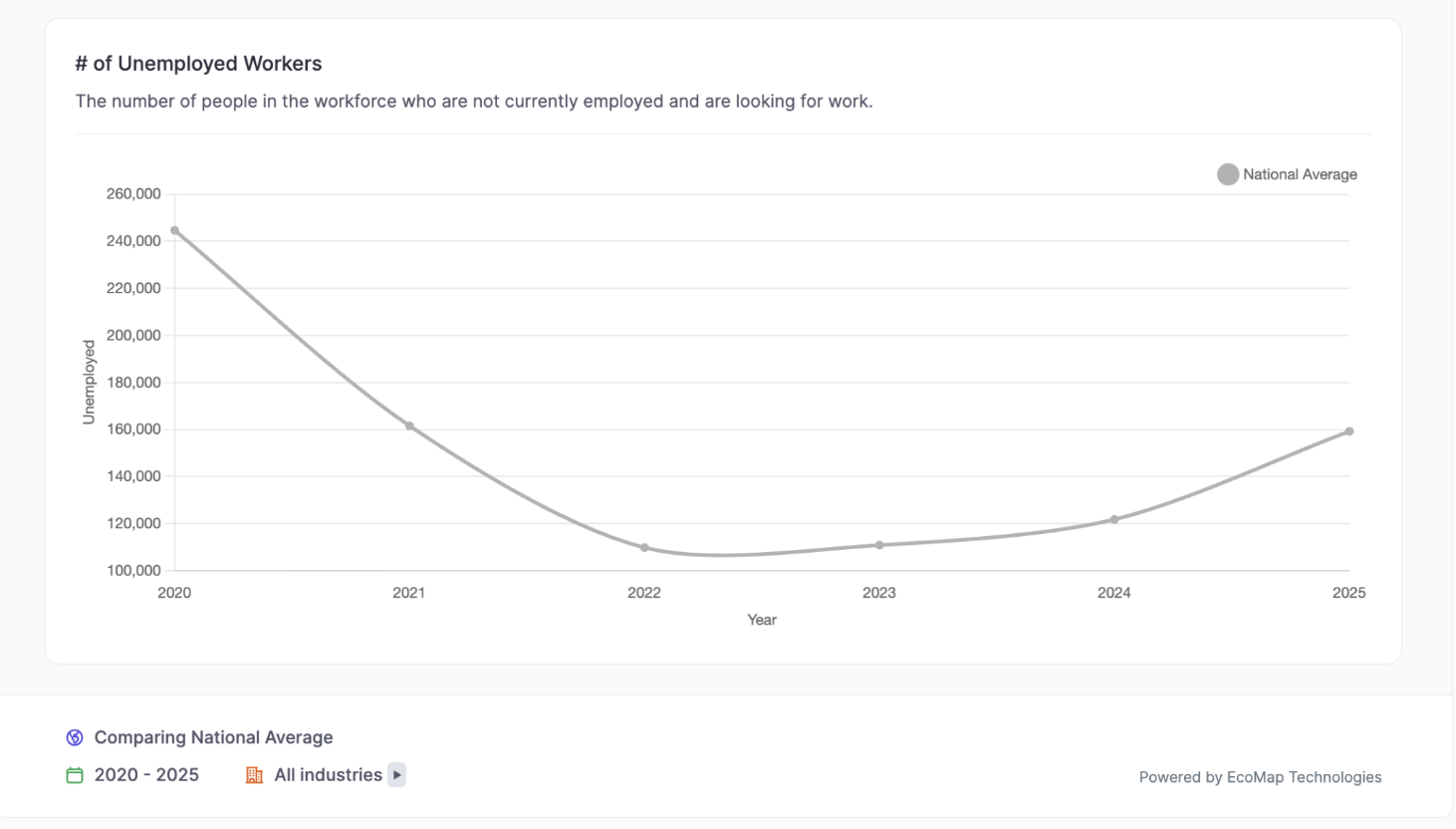
We do not count how many businesses in a state are transitioning, how many are finding buyers, how many potential founders are in the pipeline, or how many of the displaced workers in one column could become the owners in the other column. The data does not exist in any usable form, at any level of government, anywhere in the country.
This is the question the Compact is circling without yet naming. Entrepreneurship is not a job creation program. Entrepreneurship is the risk distribution mechanism that produces economic resilience. Resilience is what a community experiences when a shock hits and it does not break. Risk distribution is the structural condition that makes that outcome possible. Resilience can't be bought, only built through the systems that create it. A state that measures only jobs and output is measuring the car’s speedometer and ignoring the fuel gauge. A state that starts measuring ownership, transitions, and the flow between displaced labor and available enterprise is measuring something closer to the real resilience of its economy.
Why the Compact matters, and where it stops
The governors who are considering signing the Compact are heading in the right direction. They are treating entrepreneurship as a state priority. They are naming senior positions responsible for it. They are proposing to measure and publicly report on it. They are, hopefully, investing in technology to make all of this happen efficiently and at scale.
A Compact commits a state to direction. The execution comes after. Signing a document does not create visibility into a state’s ecosystem. Naming a director of entrepreneurship does not automatically connect her to the thousands of businesses, support organizations, capital providers, and founders already operating in disconnected silos across her state. Setting a goal for reducing startup barriers does not tell you which barriers are binding for which founders in which counties.
Every governor who signs the Compact in July will walk out of Oklahoma City facing the same practical problem. They will need to answer three questions that their current data likely can’t.
Can they see the ecosystem they are now responsible for? Do they know which businesses exist, which support organizations serve which founders, and where the gaps are, not just the ones they assume?
Can they route through it? When a displaced worker in a rural county wants to buy a retiring owner’s business, is there a pathway from unemployment office to SBDC to lender to transition, or is there a forty-phone-call scavenger hunt?
Can they measure it? Not just startup counts, but small business, resource availability and usage, and, ultimately,the lived prosperity of the people those businesses employ.
These questions sit outside ideology and party. They are infrastructure questions. The states that can answer them by the end of 2026 will be running a fundamentally different playbook than the states that cannot, regardless of what their governor signed in July.
What the next move looks like
The Compact is the right signal. The underlying diagnosis, that America’s economic engine needs a functioning pipeline from ambition to ownership, is correct. The bipartisan framing is promising. The measurement language in the Compact is on the money.
What is missing, and what every signatory will need to build or buy in the months after they sign, is the coordination and visibility layer that makes any of it real.
The governors who move first on that layer are the ones who will have something to report at the next NGA meeting, and the one after that. They will be able to walk into a room of economic developers and show a map of their state’s businesses, support organizations, and capital sources, in a single view. They will be able to track whether startup activity is actually rising in the counties where AI displacement is hitting hardest. They will be able to answer the equilibrium question for their state.
The ownership transition cliff is coming whether or not the Compact is signed. The 22 states on Zandi’s list can’t wait to move on this. AI is going to keep expanding the national output number while local economies risk cracking underneath it. The only open question is how many governors recognize, between now and July, that the Compact they are being asked to sign commits them to building an infrastructure their states have never had but certainly need.
The governors considering the Compact asked the right question. The harder one, which the summer meeting in Oklahoma City won't resolve, is whether anyone has built the system to act on the answer.
Sources & Further Reading
A short list of the primary sources behind this piece, plus the deeper reading that informs the argument. Where a single source carries multiple data points, it is grouped accordingly.
On the Compact and the NGA initiative
National Governors Association. Governor’s Compact on Entrepreneurship. The full text of the Compact, the list of strategies it asks governors to adopt, and the connection to Gov. Stitt’s Executive Order 2026-04. nga.org/projects/governors-compact-on-entrepreneurship
National Governors Association. Reigniting the American Dream (Chair’s Initiative). Background on the three-pillar framework (Unlocking Economic Opportunity, Empowering Every Learner, Energizing the Future) that the Compact sits inside. nga.org/americandream
On the 22-state recession picture and the GDP-versus-prosperity gap
Christy Bieber, “Roughly half of U.S. states are effectively in a recession and ‘hanging on by their fingertips,’ Moody’s chief economist says,” Fortune, October 9, 2025. The original Zandi interview behind the “22 states contracting, 16 growing, 13 treading water” framing and the “hanging on by their fingertips” quote.
Mark Zandi (@Markzandi), X/Twitter posts on the Vicious Cycle Index and state-level recession data, 2025–2026. Useful primary source for the methodology behind the state classifications and the “nearly a third of U.S. GDP” figure.
Suzanne Woolley, “US Recession Risk Is Receding as We Move Into 2026,” Bloomberg, December 15, 2025. Captures the “four pillars” framing (labor market, inflation, consumer, AI) that Zandi uses to describe how fragile the national number really is.
On the small business landscape and the succession cliff
U.S. Small Business Administration, Office of Advocacy. 2025 Small Business Profile. The canonical numbers: 36.2 million small businesses (99.9 percent of U.S. firms), 62.3 million employees (45.9 percent of private-sector employment), and 43.5 percent of GDP. Also: small businesses generated 88.9 percent of net new jobs from March 2023 to March 2024. advocacy.sba.gov
Project Equity. Silver Tsunami: Small Business Closure Crisis. The most rigorous nonprofit treatment of the succession problem. Estimates 2.3 million baby-boomer-owned small businesses representing roughly one in six U.S. jobs, and lays out the local-economy mechanics of why closures cascade through communities. project-equity.org/impact/silver-tsunami
U.S. Bank. 2025 Small Business Perspective Survey. National survey of 1,000 owners. The cleanest single source for the succession-planning gap (more than half of owners are 55+, only 54 percent have a formal plan, 37 percent plan to sell within 12 months) alongside parallel data on AI adoption and stress, which is the equilibrium question this piece is asking, framed at the firm level rather than the state level.
Tony Guidotti et al., “Employee ownership can help weather the ‘silver tsunami,’” Harvard Business School Institute for Business in Global Society, October 9, 2025. Useful for the “only 20 to 30 percent of businesses that go to market actually sell” data point (Exit Planning Institute) and the policy framing of the closure cascade.
On AI displacement, the labor side of the equilibrium question
Inc. magazine article on the AI workforce shift and small-business succession. https://www.inc.com/sherrod-davis/the-new-workforce-is-entrepreneurial/91320694
Anthropic. Anthropic Economic Index (ongoing reports on AI’s effect on labor markets and which tasks are being automated first). The most current public dataset on actual AI usage patterns by occupation, useful for grounding any claim about which workers face displacement first.
Companion reading from EcoMap
Sherrod Davis, “From Growth to Prosperity,” EcoMap, January 2026. Introduces the Gross Domestic Prosperity (GDPp) framework that this piece extends, the four pillars (Income Momentum, Employment Stability and Quality, Enterprise and Ownership Density, Cost-of-Living Pressure) being the lens through which the “output is not prosperity” argument here should be read. https://ecomap.tech/blog/from-growth-to-prosperity/
Sherrod Davis, “When Intelligence Becomes Abundant, What Are Humans For?,” EcoMap, February 2026. The companion piece on AI’s labor-side disruption and the ecosystem builder’s role in absorbing it; introduces the Ecosystem Resilience Rating concept that pairs with GDPp as a leading indicator. https://ecomap.tech/blog/when-intelligence-becomes-abundant-what-are-humans-for/