


Where research meets ecosystem building
Dr. Emily Yeager directs the Crisp Small Business Resource Center in the Miller School of Entrepreneurship at East Carolina University. She's also an associate professor in the Department of Recreation Sciences and Sport Management. Her work sits at the intersection of academic research and practical economic development, with a focus on rural communities in eastern North Carolina.
The Crisp Center was established in 2019 through a $1 million gift from ECU College of Business graduates Matt and Kim Crisp. It serves a 29-county region in eastern and northeastern North Carolina, 28 of which are rural. Through the center, Emily and her team support small business owners and the organizations that serve them across a region where resources exist but are often disconnected, difficult to find, and unevenly distributed. Her guiding question is a simple one that drives complex work. How do you make a place better than it was before you got there?
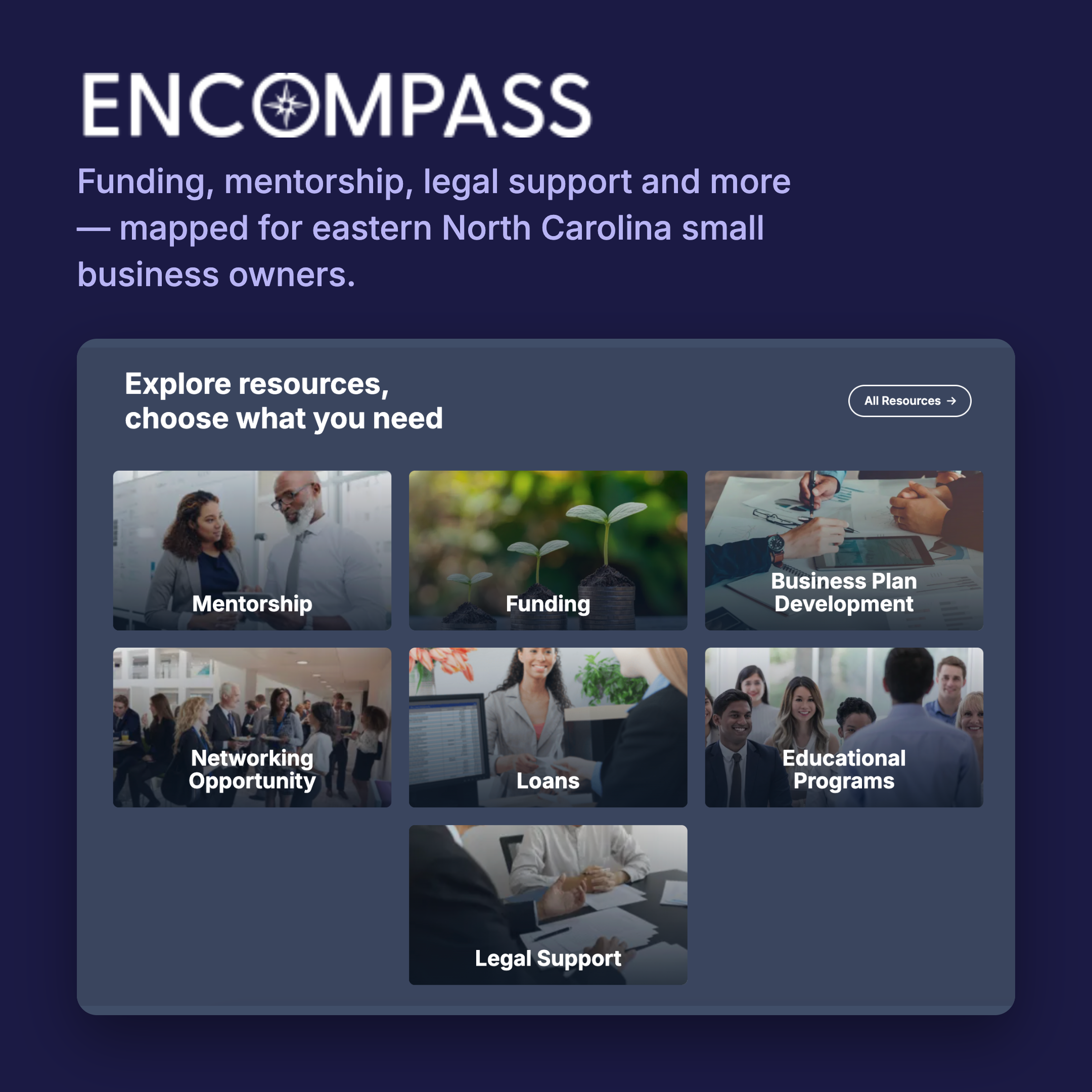
In partnership with EcoMap, the Crisp Center launched ENCompass, a digital platform that maps the entrepreneurial ecosystem across Pitt County and the surrounding region.
Building for rural communities on rural terms
Rural ecosystems operate differently than urban ones. The geographic distance between assets is greater, the organizations doing the work are often smaller, and the relationships between them carry more weight. Emily's approach to ecosystem building accounts for all of that.
Her team developed the Entrepreneur Ready Communities Certification (ERC), a research-backed framework that helps communities assess the health of their entrepreneurial ecosystems. The program goes beyond listing what exists. It evaluates whether assets are working together effectively, whether resources overlap or leave gaps, and whether the priorities identified by ecosystem leaders match what small business owners on the ground are experiencing.
The ERC process starts with tactile, in-person workshops where community stakeholders physically map their assets and relationships before any digital tool enters the picture. That approach makes the work accessible to communities regardless of their technical capacity and builds the buy-in needed for long-term adoption.
EcoMap as the infrastructure layer
ENCompass, the Crisp Center's EcoMap-powered platform, serves as the digital foundation underneath the ERC framework. As communities work through the certification process, the assets they identify, vet, and prioritize are reflected in ENCompass, creating a living, community-validated view of the ecosystem.
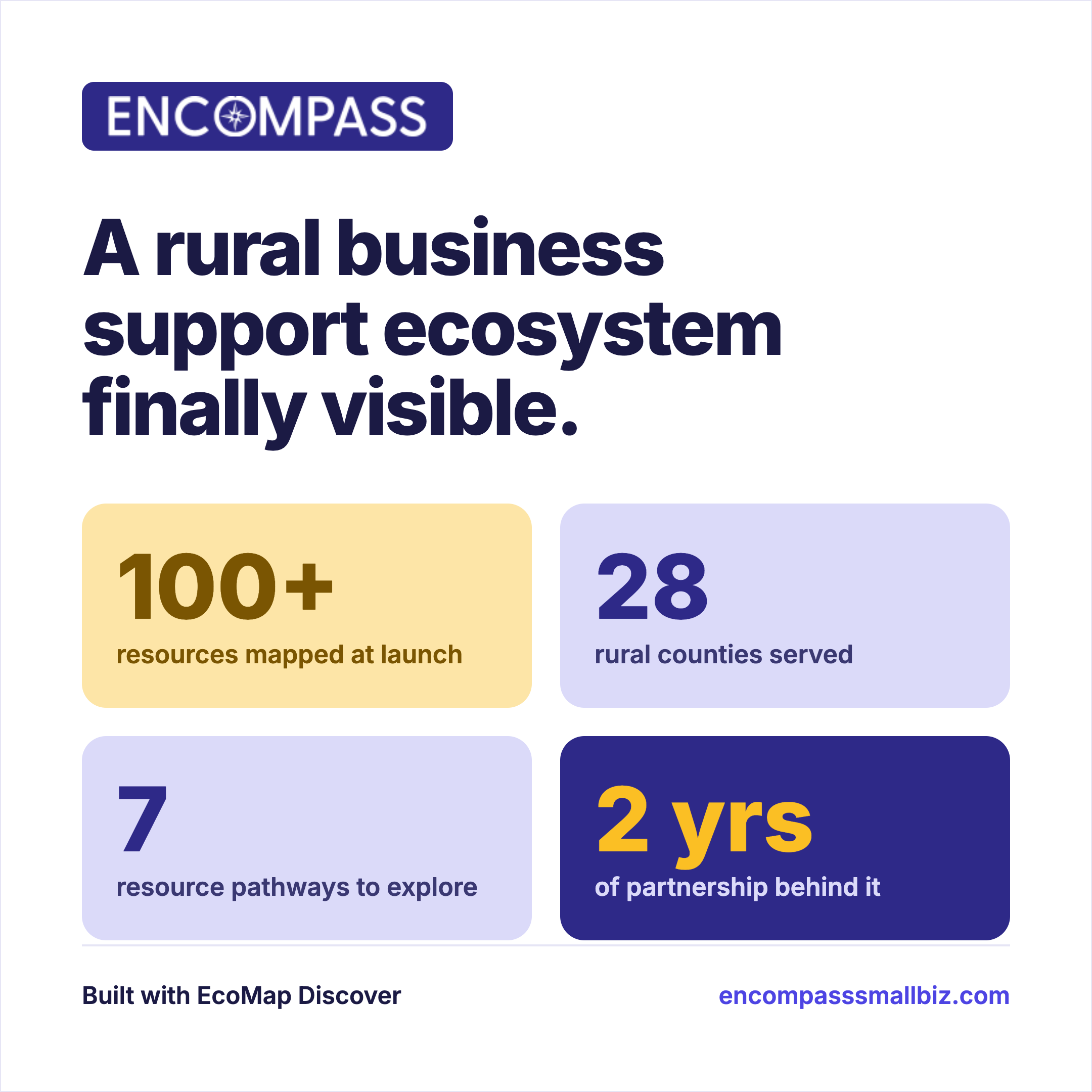
The platform started with roughly 100 base assets concentrated in Pitt County and a handful of surrounding counties, along with statewide resources. As the Crisp Center expands its work into new communities through programming like RISE 29, an internship program for small business owners funded by the Golden Leaf Foundation, the map grows with them.
Emily has described EcoMap as the "undercurrent tool" that supports everything the Crisp Center does. It gives communities a way to see what they have, track what's changed, and share that information with the partners and funders who need to understand the ecosystem's strengths and gaps.
Capacity before technology
One of Emily's core insights is that tools alone don't change how ecosystems work. Communities need to understand the fundamentals of ecosystem building before a digital platform can be effective. She compares it to handing someone a drill without explaining that there are different bits for different materials. The tool is powerful, but only if the person using it has the foundation to use it well.
That's what the ERC is designed to provide. By walking communities through asset mapping, gap analysis, and priority-setting before introducing digital infrastructure, the Crisp Center builds the capacity that makes platforms like EcoMap sustainable over time. It's a model that positions ECU not just as a service provider but as a trusted guide for rural communities navigating ecosystem development.
A two-year partnership and growing
The Crisp Center has been working with EcoMap for more than two years. What started as a single ecosystem map for Pitt County has evolved into a broader strategy for expanding digital infrastructure across eastern North Carolina's rural communities.
Emily's work continues to grow. The Crisp Center is piloting the ERC in new communities, exploring grant funding to sustain and expand the accelerator program, and building relationships with statewide partners who see the value of connected ecosystem infrastructure. Each step extends the reach of what started as a local initiative into something with potential to serve as a model for rural ecosystem building across the state.
Learn more about the Crisp Small Business Resource Center at https://business.ecu.edu/msoe/Crisp/.
Explore ENCompass: https://encompasssmallbiz.com/
Frequently Asked Questions
What is ENCompass? ENCompass is the digital tool the Crisp Center built with EcoMap to map the entrepreneurial ecosystem across Pitt County and the surrounding region. It started with roughly 100 base assets and continues to grow as the Crisp Center expands into new communities.
How does ENCompass connect to the ERC framework? ENCompass serves as the digital foundation underneath the ERC process. As communities work through certification, the assets they identify and prioritize are reflected in ENCompass, creating a living, community-validated view of the ecosystem that can be shared with partners and funders.
What is RISE 29? RISE 29 is an internship program for small business owners, funded by the Golden Leaf Foundation. It's one of the ways the Crisp Center is extending the ERC framework and ENCompass into new communities beyond Pitt County.
What is the Entrepreneur Ready Communities Certification (ERC)? The ERC is a research-backed framework developed by the Crisp Center to assess the health of a community's entrepreneurial ecosystem. Rather than simply cataloging available resources, it evaluates whether those resources work together effectively, whether they overlap or leave gaps, and whether the priorities of ecosystem leaders align with what small business owners are experiencing on the ground. The process begins with in-person workshops where stakeholders map their assets by hand before any digital tool is introduced.