
A small Catholic university with a faculty learning agenda
Holy Family University is a private Catholic university with campuses in Northeast Philadelphia and Newtown, Bucks County. Founded in 1954 by the Sisters of the Holy Family of Nazareth, the university enrolls about 3,500 students across four schools: Arts & Sciences, Business & Technology, Education, and Nursing.
Dr. Don Goeltz, a professor in the School of Business & Technology, has spent two decades at Holy Family after an earlier career in corporate strategy and entrepreneurship. He also has a history with EcoMap. Several years ago, he built the Philly Venture Hub, a resource connecting Philadelphia-area entrepreneurs to the local business ecosystem, with EcoMap powering the underlying database. When Holy Family's faculty needed a way to keep pace with AI, Goeltz turned to EcoMap again.
The meeting that couldn't hold what needed to be learned
As faculty across Holy Family began experimenting with AI in their courses, small informal meetings sprang up so professors could share what they were trying. Someone would describe a tool they used for research, another would talk through how they handled AI in a writing assignment. The content was useful. The problem was what happened after: a half hour wasn't enough time to absorb everything shared, and once the meeting ended, the knowledge had nowhere to go. There was no way to revisit what was said, and no way for a professor who missed the meeting to catch up.
This is a familiar challenge, especially at smaller universities which often lack the dedicated staff to build out the formal AI hubs - generally centralized, publicly published collections of guidelines and resources - that larger institutions have.
An AI Teaching Hub built inside Canvas, where faculty already live
Dr. Goeltz's answer was to build a shared, searchable database of how Holy Family faculty are actually using AI, then put it somewhere professors would encounter it without having to look for it. Rather than a standalone website, the tool lives inside Canvas, the learning management system faculty already opens several times a day to post assignments, run quizzes, and check grades. It shows up on the dashboard the same way a course would.
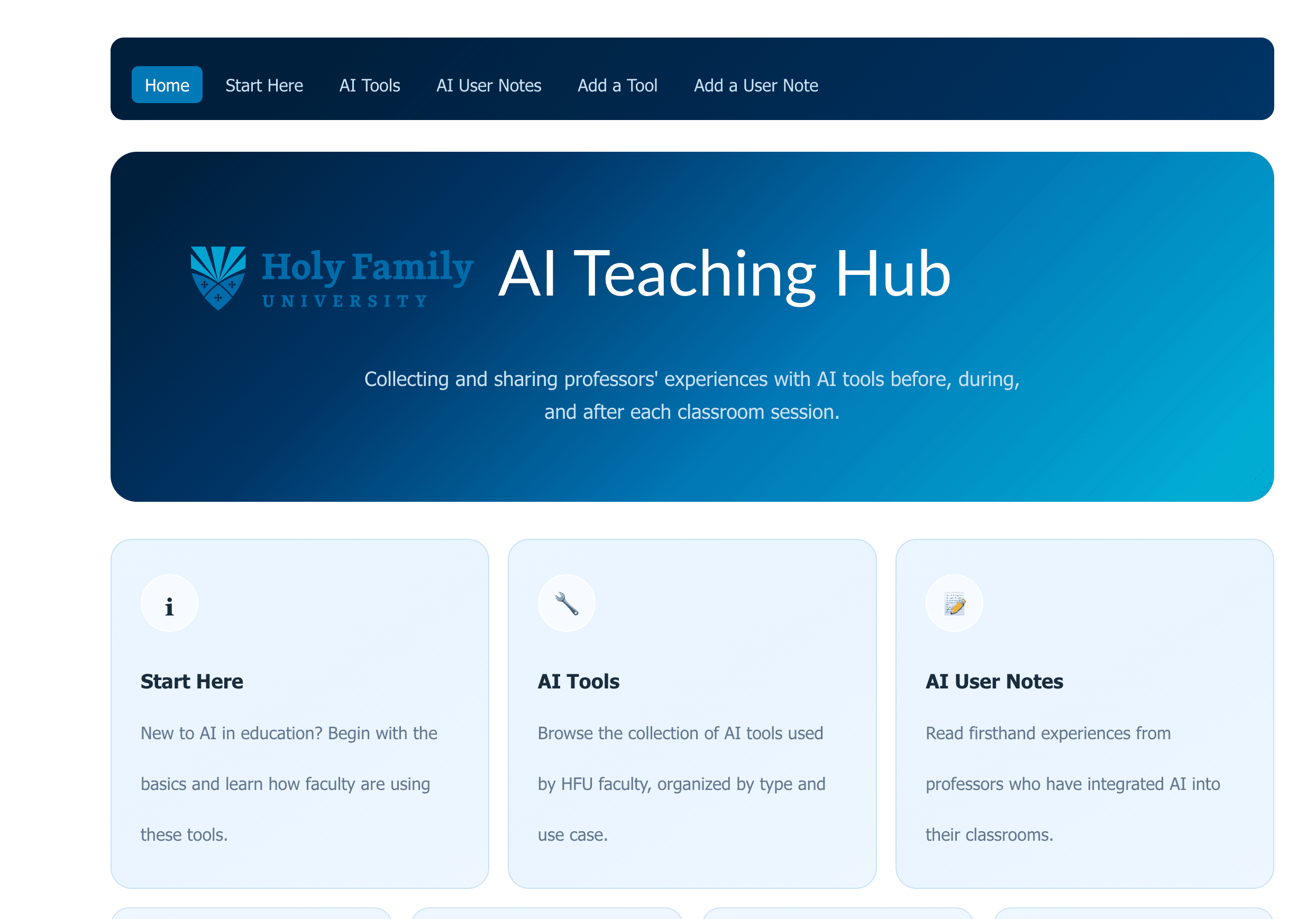
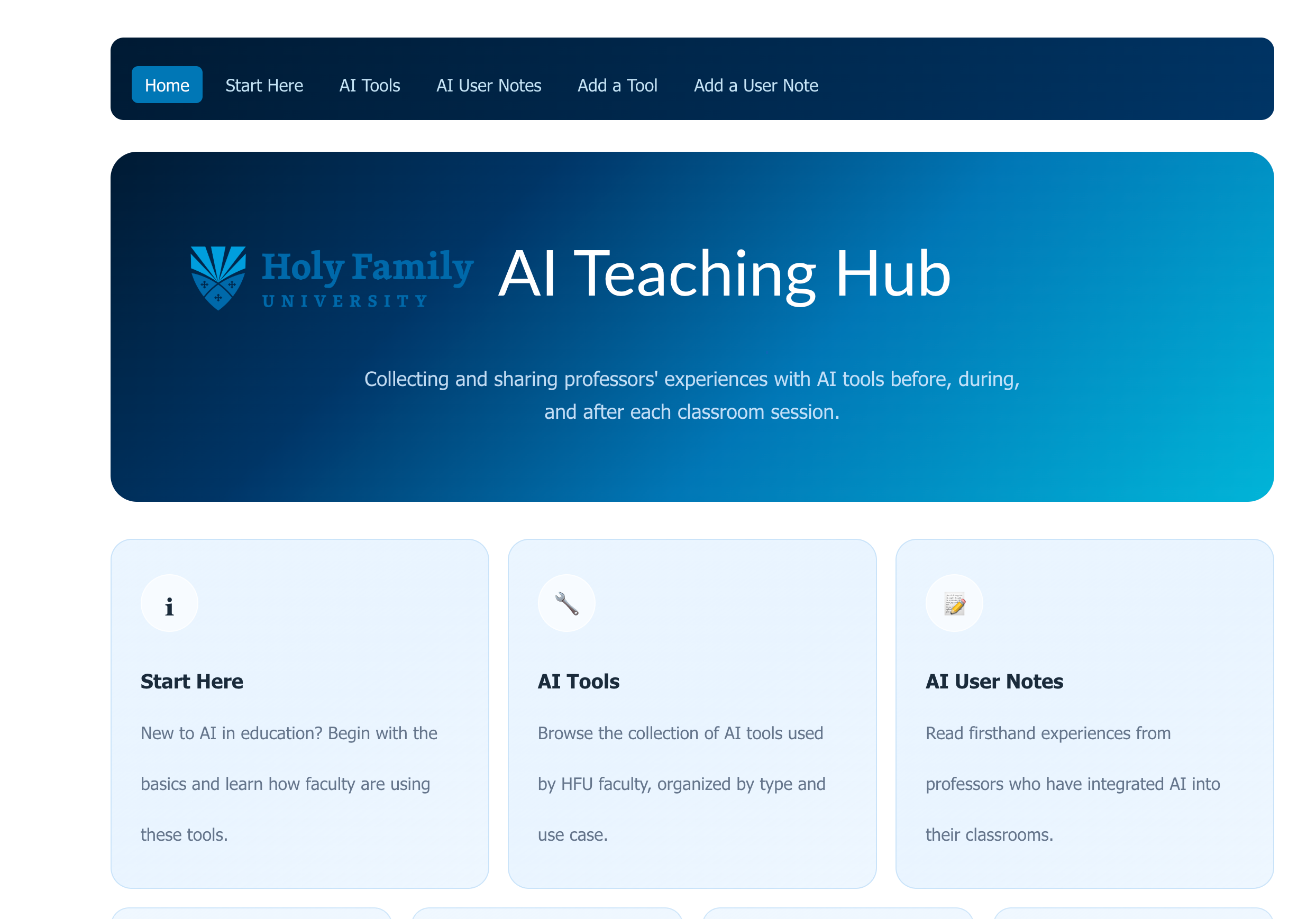
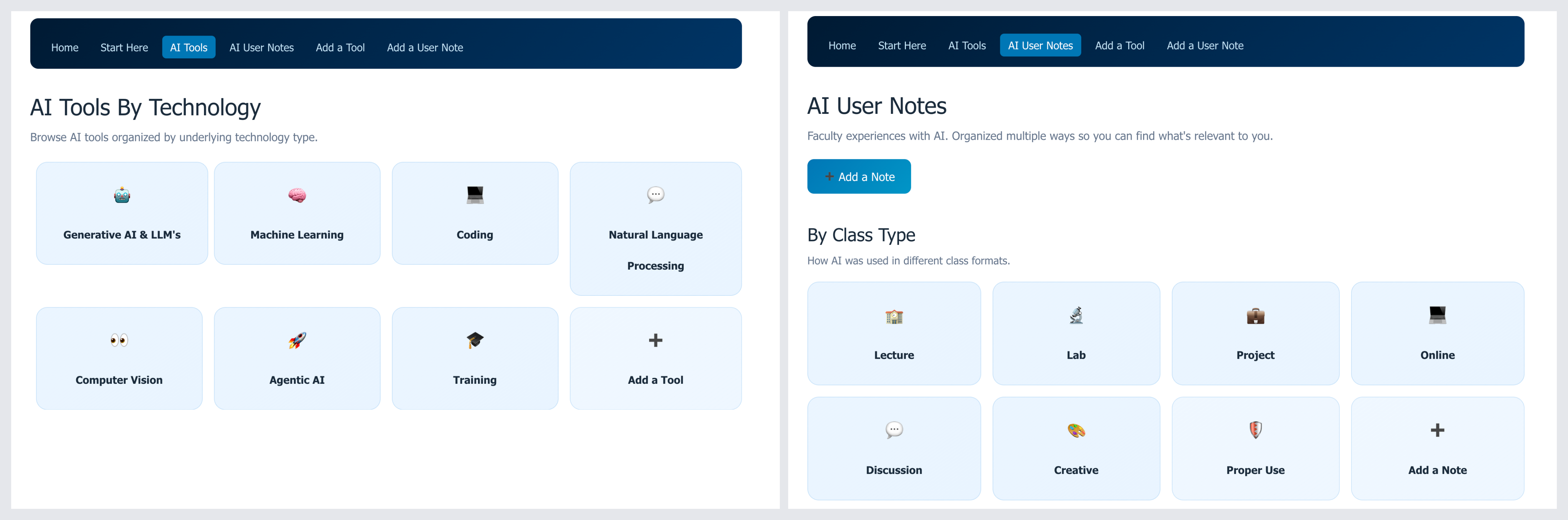
Two recent HFU alumni who formed their own technology consulting company, Vertical AI, worked with Goeltz and Holy Family's Canvas administrator to develop the interface. EcoMap supplies the underlying Discover database and search capability. The result is the AI Teaching Hub: a Home page, a Start Here orientation for new users, an AI Tools directory organized by category (generative AI and large language models, machine learning, coding, agentic tools), an AI User Notes section where faculty describe how a tool worked in their own classroom, and simple submission forms for adding a tool or a note. Everything is tagged with keywords and runs through EcoMap's search, so a professor can find what a colleague in another department already learned.
The Hub is deliberately kept internal to faculty rather than opened to students. Professors share their email addresses alongside their entries, so a colleague can reach out directly and ask how something worked. A biology professor using an AI tool in biochemistry doesn't need every other faculty member to become an expert in it. They need a way to be found by the two or three people on campus who could actually use that expertise, and a way for an English professor navigating AI and academic integrity in writing courses to pass along what they've figured out to everyone else still working through it.
Knowledge as a strategic resource, not just a teaching aid
Dr. Goeltz has studied knowledge as a strategic resource, a concept with roots in management research going back to 1960s work on centralized knowledge bases, McKinsey & Company's practice among them. Applied to a university faculty, that idea holds that centralizing what people already know increases productivity and innovation and keeps expertise from disappearing when someone retires or moves on. That concept hasn't been applied to AI in teaching and learning at smaller institutions in quite the way Holy Family has pioneered.
The stakes go beyond convenience. Faculty at Holy Family are addressing three concerns at once: preparing students for a job market where nearly every role now references AI in some form, teaching students to use AI to build their own capabilities rather than lean on it as a shortcut, and managing the academic integrity questions AI raises in every discipline differently.
A capstone strategy course that once had students dissect a public company using traditional analysis tools has evolved because that kind of analysis is now something students can generate with an AI tool in minutes. The Hub is where faculty work through changes like that in the open, in front of colleagues facing the same shift in their own courses.
A second project with an already-familiar partner
Dr. Goeltz secured a small internal grant from the university and signed on with EcoMap to build the Hub, drawing on the same database and search infrastructure that powered Philly Venture Hub. Having already worked through what EcoMap's platform could do on that earlier project made this one more straightforward to scope, even as the audience and use case shifted from external entrepreneurs to internal faculty.
The rollout was also built for adoption from the start. Rather than launching solo, as he had with Philly Venture Hub, Dr. Goeltz assembled a steering committee with one representative from each of Holy Family's four schools, along with the Canvas administrator, whose job is to bring the Hub back to their own faculty and get people using it. The group includes at least one early skeptic who has since become an advocate, and the university's Vice President of Academic Affairs has stayed informed and supportive throughout.
Built for a fall launch, with room to grow every semester
The Hub was built and beta-tested between January and June, and is now fully operational, with Dr. Goeltz populating the database ahead of a full launch this fall alongside the new semester. Promotion runs through the steering committee and Holy Family's Faculty Senate, which meets monthly and gives Dr. Goeltz a standing venue to spotlight new tools, new user notes, and the faculty contributing them.
The next challenge is the one common to any shared knowledge base: it gets more valuable the more people put into it, and that takes sustained attention across semesters, not just a strong launch. Faculty forget over winter and summer breaks the way anyone does, so re-introducing the Hub each semester, alongside the start of the academic year, is already part of the plan.
Holy Family has created an innovative faculty-built, faculty-maintained solution to knowledge sharing that is tailored to the workflow of the University's professors and the needs of its students.
Learn more about Holy Family University at https://www.holyfamily.edu