

We are in a pace race
How fast should we build AI, and who decides? NVIDIA’s CEO told the President we are not going to let an AI slowdown happen. Anthropic's CEO laid out a plan to pace the frontier. Axios says the boom can absorb a slowdown and catch its breath. The Washington Post says investors are trying to price what a slowdown would cost. Trump said, "The country that wins AI, wins."
Every story needs a villain, and in this one the authors have made the villain China. For the most part, that framing is useful to everybody who uses it, which is a reason to be suspicious of it. It turns a set of choices we are making into a race we are running, and races have the convenient property that you do not have to justify your direction. You only have to justify your speed.
But I think it’s helpful to, to a certain extent, think of this less as a race and more of a voyage. The tension is not between us and a rival. It is between us and the decisions we make or don’t make. The Gates Foundation's 2026 Goalkeepers report opens by saying AI could be a great equalizer or it could widen the gap. Further, it says "This is not a long-range prediction. It's a present-tense choice."
Here is what strikes me about the pace debate. It is being conducted at 30,000 feet, between people who own frontier labs and people who regulate them or decide not to. Meanwhile the decisions that will actually determine who benefits from this buildout are being made in county planning commissions, utility rate cases, and chamber board meetings, by people who were not invited to the podcast.
That’s what I want to focus on here.
What we still agree on
I want to start from something that unites us.
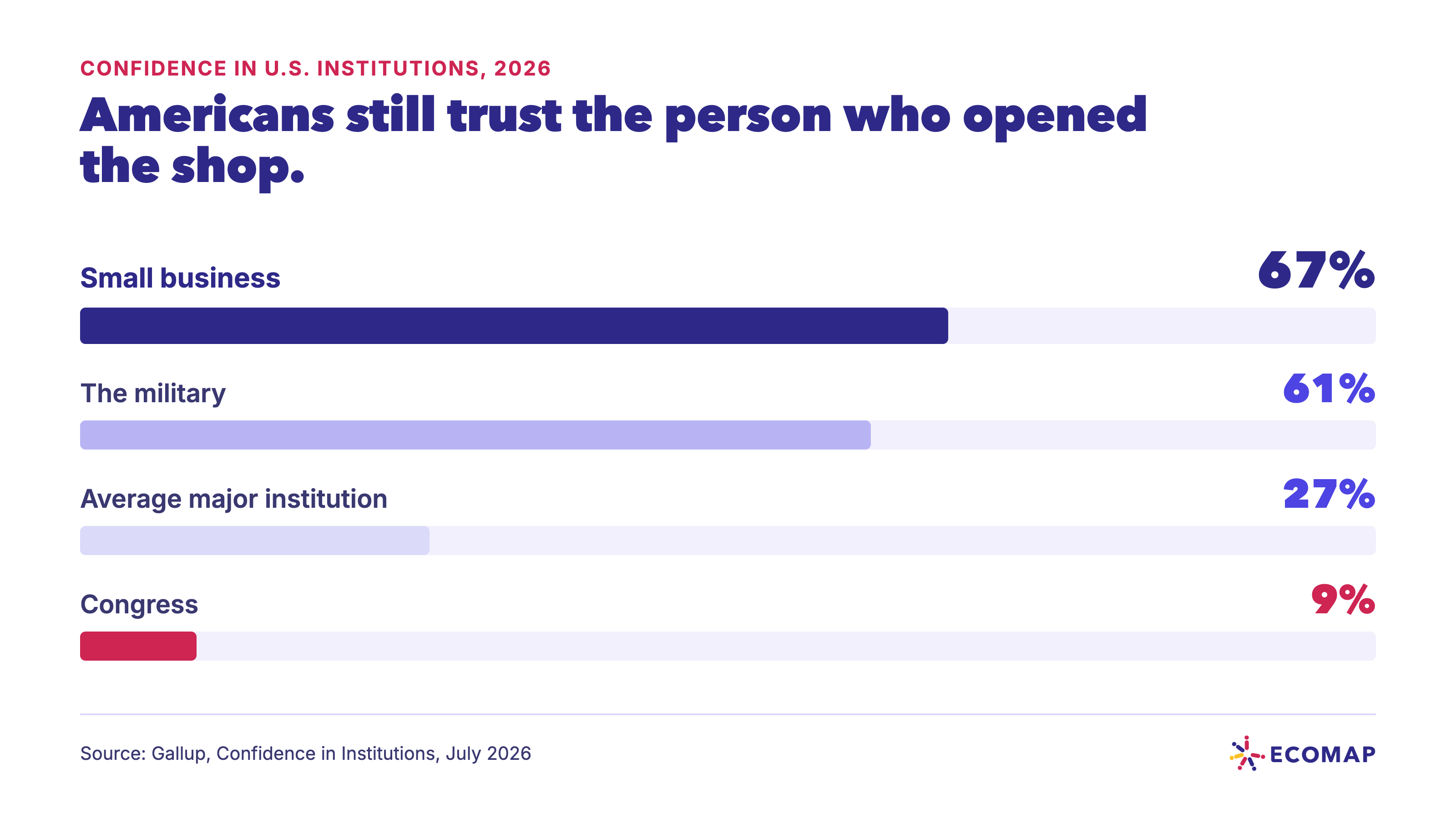
Americans trust small business. In Gallup's 2026 confidence survey it sits at the top of the list at 67 percent, ahead of the military at 61, in a year when average confidence across major institutions was 27 percent and Congress landed at 9. It is also the rare institution where the partisan gap nearly closes. Seventy-nine percent of Republicans, 65 percent of Democrats, 62 percent of independents. Fourteen points from end to end. The same survey puts the partisan gap on the presidency at 70 points. Whatever else has fractured, we still believe in the person who took the risk and opened the shop. Most economic arguments in this country have to win a fight about values before they can start. This one doesn’t. The agreement is already there. And the belief is well placed. Stephen Slivinski’s analysis of all fifty states found that for every one percentage point increase in the entrepreneurship rate, there is roughly a two percent decrease in poverty. Entrepreneurship is not a feel-good category. It can be the mechanism for a brighter future.
That mechanism is running hot right now. The Small Business and Entrepreneurship Council reported more than 1.6 million business applications filed over the summer, that is worth paying attention to. The Census logged 578,926 applications in July alone, up 8.1 percent over June. JP Morgan’s CEO has described a mini boom in small business.
My guess is that AI is part of what is driving this. AI lowers the cost of starting something (at least for now), which means more people start something, which means more demand for compute, which means more infrastructure, and the founders who want to compete will have to use the tools, which drives more demand still. It is a cycle, and we are early in it.
So, we’ve got agreement and momentum.
Here is what we don’t have.
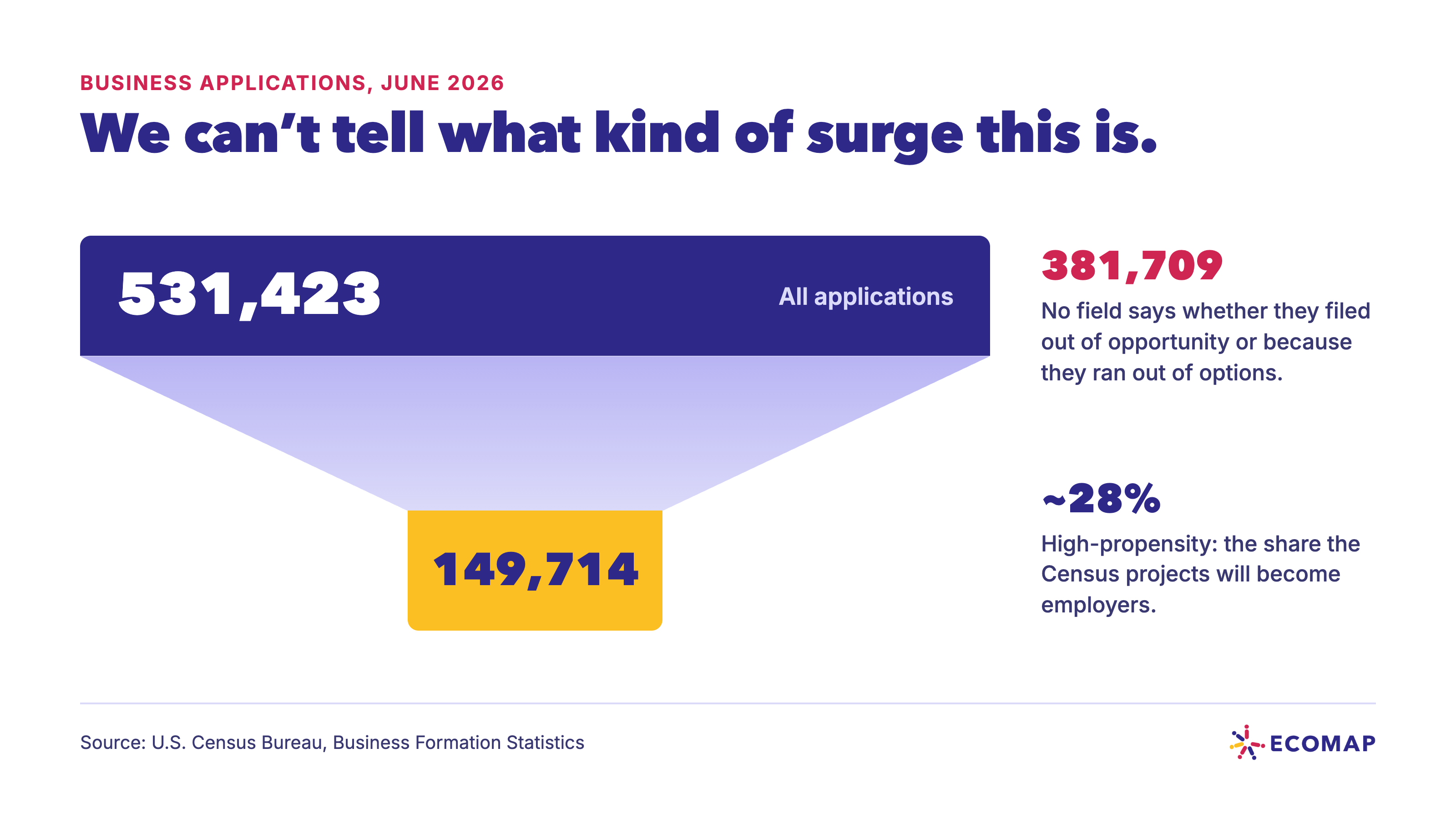
In June, total business applications were 531,423. High-propensity applications, the subset the Census projects will actually become employers, were 149,714. About twenty-eight percent. And of the roughly 36.8 million business firms in this country, about 30.4 million are non-employers.
I am not saying the surge is fake. I am saying we cannot currently tell what kind of surge it is, because we do not collect the information that would let us. A business application has no field for whether you filed it because you saw an opportunity or because you ran out of options.
My friend Donna Harris framed the stakes of that distinction better than I have seen anyone frame it. Writing in her Builders Field Guide, she looks at what happened when Waymo automated the driving out of a Lyft driver's job, and points out that the rest of the work did not disappear. It got unbundled and reassigned into something that looks like a hierarchy: owners who hold the capital and the models, machines that do the economically valuable work, and humans who service the machines. Her line:
"The robot drives. The human cleans the robot."
I, for one, would like to avoid a turn to feudalism.
Her point, and it is the right one, is that this is not predetermined. AI lowers the cost of creating and owning things, which means it could push far more people into the ownership layer. Entrepreneurship is how people participate in the upside of this new technological wave. Agreement we have. Momentum we have. What we are missing is sight. And there is a place where all three are being tested at once, on specific parcels of land, with specific construction budgets, in counties that are voting on it this year.
Both Sides Are Making the Same Point
At the 2026 Detroit Policy Conference in January, Walbridge Chairman John Rakolta Jr. called a data center the most fantastic economic development opportunity in the last 150 years. I wrote about that in April, and I still think he is directionally right.
The mood has changed since then. More than 100 local communities have enacted moratoriums. More than 300 state data center bills were filed in the first six weeks of 2026. Senators introduced a federal moratorium act in March. Virginia, Georgia, and Oklahoma, states that once competed to offer the biggest incentives, are reconsidering them. In the regional grid that serves 65 million people across Pennsylvania, Virginia, Ohio, and eleven other states, the cost of guaranteeing future power supply went from $2.2 billion to $14.7 billion in a single year, with data centers accounting for nearly two-thirds of the increase.
The argument, repeated in county after county: One side says out-of-state corporations will capture the money and leave us the power bill. The other side says the project creates jobs.
Both sides are making the same point from opposite directions. Both are arguing about whether value will stay local. And neither has checked which local firms can actually do the work. Dany Bahar and Greg Wright at Brookings put it plainly when they updated their research on data center employment effects in August: "the labor market dimension of this debate has been conducted largely without data."
What the Evidence Says, and Why It Should Change the Playbook
Bahar and Wright assembled about 1,500 U.S. data center facilities plus 52 announced-but-canceled projects, and compared counties that got a facility to counties that almost did. That control group matters, because data center sites are chosen for cheap land, power, fiber, and recent growth. Counties that land them were typically already growing faster. Compare them to everyone else and you will overstate the effect.
Their findings, in short. Data centers do create local jobs, roughly 100 to 200 in a typical county, with data processing employment up 56 percent over the first decade and telecommunications up 43 percent. Wages were unchanged. Home prices rose 2 to 5 percent.
Then comes the finding that should reorganize how states run this play.
Not all data centers are the same. Hyperscale campuses are the ones Amazon, Google, Microsoft, and Meta build to run their own workloads. Colocation facilities are built by landlords who lease space to tenants who may have no local presence at all. A landlord builds the shell, the power, and the fiber, then leases space to tenants who install their own servers and may never set foot in the state. Think of it as a warehouse for other people’s computers.
Bahar and Wright found that hyperscale campuses generate real ecosystem effects, including a 43 percent rise in telecommunications employment, because a campus like that needs high-capacity fiber and network operations on site.
Colocation facilities do not produce that effect. Now put the subsidies next to that.
In counties that landed hyperscale campuses, state incentives came to about 2 percent of what was spent on construction. The company was going to spend billions either way, and the research suggests these siting decisions turn on power, land, and fiber rather than tax breaks. The public contribution is close to a rounding error, and it probably is not what closed the deal.
In counties that landed colocation facilities, incentives came to 62 percent of construction investment. At that point the public is not sweetening a deal. It is co-financing the project.
So we pay least where the benefit is largest and our money was likely not needed, and most where the benefit is smallest and our money is doing most of the work.
This is not a story about greedy companies or foolish officials. It is a story about instrumentation. If the only number on your dashboard is announced capital investment, you will optimize for announced capital investment, and you will hand the largest checks to the projects that move that number fastest. You cannot manage a variable you are not measuring, and you will over-manage the one you are.
In June, I wrote that a state measuring only jobs and output is reading the speedometer and ignoring the fuel gauge. The data center debate is that argument made physical, on a 200-acre parcel, with a utility bill attached.
The Question Nobody Can Answer
Here is what makes this an opportunity rather than a lament.
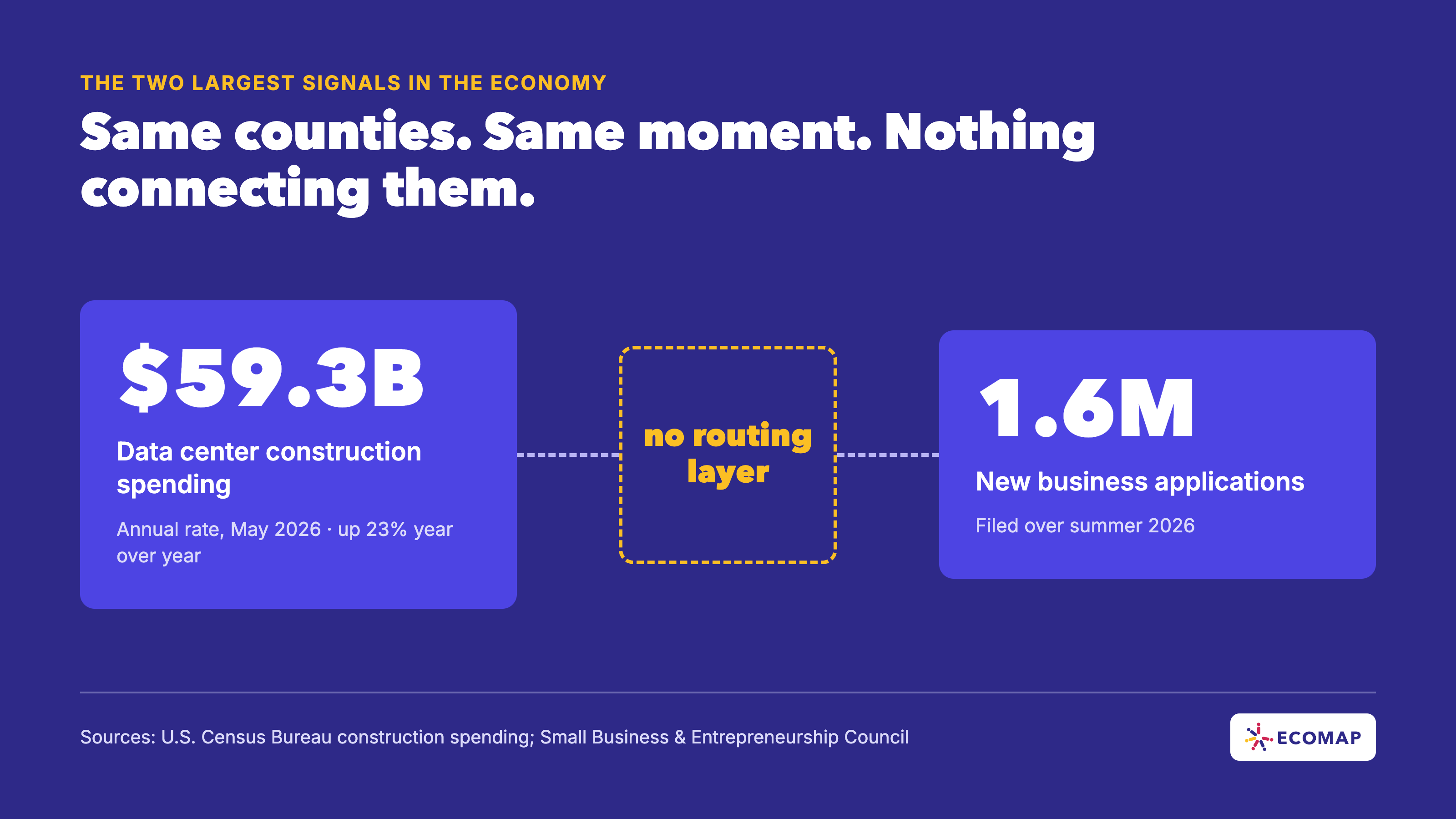
Data center construction spending hit $59.3 billion at a seasonally adjusted annual rate in May, up 23 percent year over year. The industry is staring at a projected shortfall of hundreds of thousands of construction workers. Peak crews on a single hyperscale campus run into the thousands. Electrical, mechanical, HVAC, sitework, fiber, security, commissioning, and the long tail of suppliers who feed all of it.
At the same time, 1.6 million Americans filed to start a business over the summer. Let me be careful about what I am and am not claiming. I am not saying the person who filed an LLC in July is going to wire a data hall. Most of those filings are solo, most are in sectors nowhere near construction, and no firm formed this summer is bonded to bid on a hyperscale campus. That is not the argument. The argument is that these are the two largest economic signals in the country right now, they keep landing in the same counties, and nothing in our system is trying to connect them. Think about what connecting them would look like. A multi-year, multi-billion-dollar procurement stream arrives in a county. Some of that work is winnable by firms that already exist there, if anyone identified what is disqualifying them. Some of it creates demand for firms that do not exist yet: specialty subcontractors, suppliers, service businesses around a site that will operate for a decade. And some of the people now filing out of necessity rather than opportunity could be pointed toward trades that are among the most durable work left in the economy.
We have the largest demand surge in a generation and the largest business formation surge in a generation, and no routing layer between them.
That gap is the whole opportunity. A region that captures a data center's construction spend through local firms, and uses the multi-year build to grow those firms into something that outlasts the project, ends up in Donna's ownership layer. A region that does not, ends up hosting the building while firms from somewhere else grow on it. The robot computes. The human guards the fence.
The difference between those two outcomes is not luck and it is not incentives. It is capacity, and specifically whether anyone knows what capacity exists.
So the question I would put to any region with a project in front of it is not whether to approve it. It is:
Can you name the local firms that could credibly bid on this work? Not a category. Names.
Do you know what is disqualifying the ones that cannot? Bonding capacity, certification, crew size, insurance, prior project scale. Those are solvable problems, but only if someone has written them down.
And can you tell whether the businesses forming in your region right now are moving toward that work or away from it?
Almost no region in America can answer all three. Not because anyone is failing, but because that information has never been anyone's job to hold.
Who is Actually Positioned to Answer It
I want to name the institutions that are closest to having this answer, because they are routinely left out of the conversation.
It is not the state, typically, which sees the region from too far away to know which firms are there and ready. It is not the county, whose authority stops at a line drawn for reasons that have nothing to do with where firms operate. It is the chamber of commerce, the regional partnership, the industry association. Their footprint is drawn by where businesses actually do business, and the firms in question are already their members.
A chamber executive can usually tell you, from memory, which three electrical contractors in the region are good and which one just lost a superintendent. That knowledge is real and it is genuinely valuable. The problem is that it lives in a person rather than a system, which means it cannot be handed to a site selector, a state legislator, or a successor, and it cannot be queried on the timeline a project actually moves.
Most membership records are contact lists. Name, company, dues status, event attendance. They are not capability records. Nobody ever built chambers the tooling to hold what they know about what their members can do, which is why the most important economic question in front of a region right now is one that only the chamber could answer and the chamber cannot look up.
That is the gap we spend our time on at EcoMap, and it’s not a glamorous infrastructure problem but it is one that decides how this voyage turns out.
Pedal Down, Both Hands on the Wheel
I do not think progress and prosperity have to stand opposed. I do not think the choice is acceleration or caution. I think the harder and better approach is to put the pedal to the floor and keep both hands on the wheel, which means staying alert to what this road has in store.
What I am sure of is that we cannot treat AI as a self-driving car with humans in the passenger seat, especially when the car runs on public investment. That is the version where we surrender the steering and then argue about the speed. It is also an answer to the question I asked in April, when intelligence becomes abundant, what are humans for. We are for driving. Deciding where the car goes and who gets a ride is one of the few tasks that has not been automated and will not be.
But you cannot steer toward something you cannot see. Before a region argues about whether to say yes, somebody should be able to open a file and answer who here can do the work.
If you are a chamber executive, an association leader, or an economic developer with one of these projects in front of you, I would like to know how you are answering that question, or what is stopping you. Let's talk: sherrod@ecomap.tech
Companion reading from EcoMap
Sherrod Davis, "From Growth to Prosperity," January 2026.
Sherrod Davis, "When Intelligence Becomes Abundant, What Are Humans For?" April 2026.
Sherrod Davis, "The Speedometer and The Fuel Gauge," June 2026.
Further Reading
On the pace debate
TechCrunch, "We don't need AI regulation, leave safety to us, Nvidia's Jensen Huang says," September 15, 2026.
Axios, "AI boom can withstand development slowdown," September 15, 2026.
Ezra Klein Podcast with Matt Sheehan, The New York Times, September 15, 2026.
On small business trust and the formation surge
Small Business & Entrepreneurship Council, "America's Entrepreneurship Surge Continues: More Than 1.6 Million Business Applications Filed Over the Summer," September 13, 2026.
Yahoo Finance, "JPMorgan CEO Jamie Dimon says small businesses are experiencing a mini boom."
On data centers and local economies
Daniel Goetzel, Mark Muro, and Shriya Methkupally, "Turning the data center boom into long-term, local prosperity," Brookings, February 5, 2026.
Anthony F. Pipa and Adam Aley, "The local implications of data centers for rural communities in the US," Brookings, March 2, 2026.
TechCrunch, "Al Gore has a surprisingly calm take on the AI data center backlash," September 16, 2026.